Thursday, 25 May 2017

Pond preparations

Like over-wintering pond life, I've been down deep and out of sight, but not without much unseen industry. Over the next 10 days I'll be filming and photographing the emergence of Emperor Dragonflies from Tyntesfield's kitchen garden pond. The pond frog will seek to wreak his revenge on the dragonfly larvae pictured below attacking his foot. 

Damselflies are already out and about and, whilst on pond filming business, I stumbled on a fox cub lolling about outside its den. A bit of a chocolate box picture, I realise now that's a photographic pitfall you escape when concentrating on bugs and weirdos. In the words of Milton Jones, "my bugbear are the insect mammal crosses"....


Fox cub getting a whiff of me upwind (schoolboy error)


Large Red Damselfly

Azure Damselfly

Frog with foot attacked by dragonfly nymph

Dragonfly nymph bitten off more than he can chew

Damselfly squadron

Friday, 21 October 2016

Ladybird Larvae Like Lime Lice

Following my chance encounter with Harlequin Ladybirds hatching, the subject of my last post, I have quickly found a new tunnel of learning to run down. I returned to the Lime tree where I had previously discovered both adult Ladybirds and pupae, determined to expand my survey. This time I found that every single one of the Lime trees on Tyntesfield's lower drive was hosting many hundreds, probably thousands of Ladybirds. With a minimal amount of extra scrutiny I was able to find not only adults and pupae, but also lots of larvae still active. 

As I was taking pictures of a larva on a leaf I became aware of a host of smaller residents - lots of fast moving tiny termite like creatures. These I now know to be Barkflies, a relatively recent (2003) renaming from Barklice in an attempt to improve their image. It certainly worked for me, I found watching them compelling as they whizzed around and interacted with one another in their micro-colony. They are the outdoor version of Booklice, not regarded as pests and, I assume, a tasty snack for a voracious Ladybird larva.

On today's gloriously sunny morning I went out to photograph the scenery, but found myself drawn back to the Ladybird Limes. The last couple of pictures show several stages of the transition from larva to adult. Next for me is to find out how long the process takes. I bought a leafed twig home with me several days ago with a couple of larvae on, but they have yet to start the transition. Camera shy perhaps.

Part of the joy of writing this blog is researching the things I observe and the glorious fact every creature has a fanbase. Here is a link for the Biological Records Centre: Barkfly subsection. It is a fine, fine thing and I give my respect and gratitude.

https://www.brc.ac.uk/schemes/barkfly/introduction.htm


Harlequin Ladybird Larva  (note tiny bug at bottom)

Harlequin Ladybird Larva

Barkfly (formerly Barklice). 

A whole colony of Barkflies were living on this single leaf

A winged Barkfly, either an adult of those above or possibly a different species.

Strangely inquisitive for 3mm long insects, this was possibly the first time they'd encountered a human. Note the filaments of webbing made by the Barkfly to create a protective net over their colony.

Harlequin Ladybird larva on Lime leaf

Larva on leaf

Harlequin Ladybird adult on leaf. Not responsible for holes.

Ladybird larva and empty pupa.

All four stages. Larva (left), pupa (bottom), empty pupal case (right) and adult (top).

Closer of above. Note how larva (far left)  has lost his bristles (except the anchors at the back) as the pupa forms.


Monday, 17 October 2016

Killer Harlequin Craze


I took a gaggle of five and six year olds on a Tyntesfield nature ramble this weekend. I was supposed to be the knowledgable one, but as ever it was new discoveries that struck me most. On the leaves at the base of a single Lime tree on the lower drive, we discovered hundreds and hundreds of Ladybird larvae in their pupal cases. Some had hatched and left empty cases, but many remained sealed. One adult ladybird was yellow and looked a lot like a pine nut. This was one that had just hatched, the spots coming through some time later.

I'd been wanting to find some pupae to film and photograph. Without finding one in the summer, I've now discovered legion. I will check the other trees along the drive to see if they are carrying the same burden. These are Harlequin ladybirds, non-native and apparently flourishing. My reference sources tell me Ladybirds emerge as adults in August before hibernating from autumn through the winter. The fact the Harlequins are hatching now in mid October in large numbers, would appear to mean they have a longer feeding and breeding season. I can't compare this to our native species without the facts at my disposal, but if their prey species (aphids and other bugs including ladybirds) are living longer due to milder autumns, then the Harlequins would appear to be making the most of it.

I took a couple of leaves home with pupae on and took the photographs below. The adult ladybird was the one seen earlier when yellow. You can see a translucence to its wing cases which I imagine disappears as it hardens and matures.

Before the ladybird pictures are some floral entries and a Cranefly unhappily stuck in a spider web. I find the Ivy flowers spectacular, modest from a distance, but highly impressive close up and a valuable source of food for many insects. This bush was a-buzz with bees, hornets and a very few wasps. To my personal vexation, someone from the National Trust had hung wasp traps from the bush. I would argue that putting traps on a natural food source is not a particularly smart way of keeping wasps away from your nearby cafe.


Ivy flower. An important source of late nectar for bees and others

Parsley very close up

Lavender looking woolly

A Cranefly. In trouble.


Cranefly in web. Wishing for shorter legs. Probably.

Ladybird pupae on Lime leaf (right hand one hatched)


Empty pupal case of Ladybird (Harlequin).


Unhatched Ladybird pupa


Ladybird pupae. Empty shell in foreground.


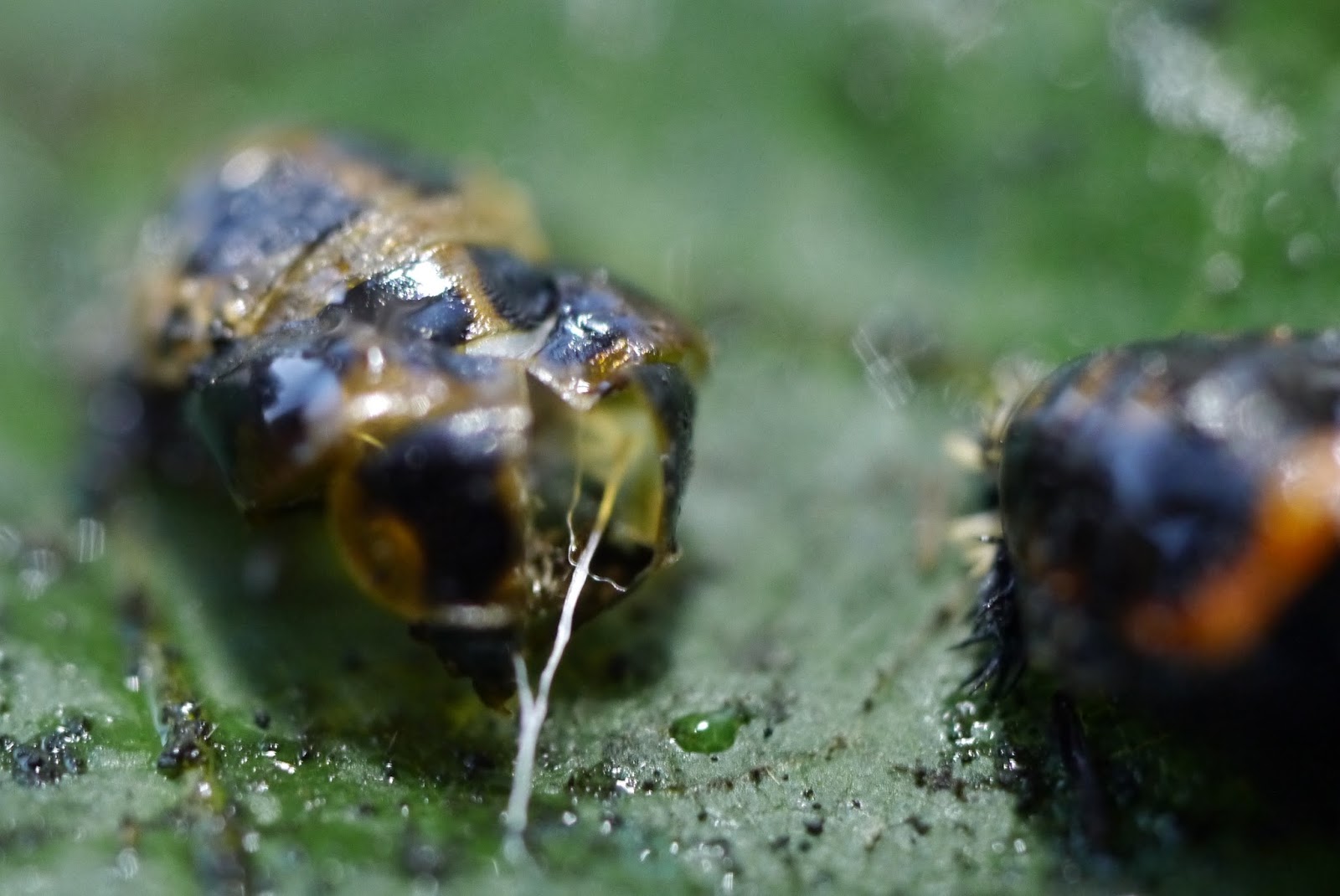
Rear end of Ladybird pupa.

Recently hatched Harlequin Ladybird. Yellow at first, the spots are now developing.

Recently hatched Ladybird, soon off to hibernate.

Sunday, 2 October 2016

Dropping the Hawker kids off at the pool

October is here and dragonflies are still in the air. The Southern Hawkers below were seen at the Home Farm pond. The bottom picture is a female who came to the pond on an egg laying mission. This particular dragonfly species lay eggs in vegetation above the water surface, or on my shoe as happened with this particular individual. When I get on with digging my own pond I shall plant said shoe in the margins in the hope the eggs hatch next spring.


Male Southern Hawker Dragonfly

Female Southern Hawker Dragonfly - laying eggs in vegetation

Sunday, 11 September 2016

Shortened Expectations

Cruelly I am now spending most of my days in a small dark room. I am feeling very nature deprived, though the fact I'm big enough to not be eaten by a spider is cause for some comfort when I do get some time outdoors.


Hop No More

Like Monet, my eyesight is deteriorating, so here's an impression of a good photo

One for my sponsors

Daddy long legs spider and food parcel

Back swim no more

Another less impressive impression of a good photo

Monday, 29 August 2016

Hawkers and Hangers


My dragonfly education continues and I'm now able to identify different species of Hawker dragonflies in the skies of Tyntesfield. At the same time I am compelled to accept that the Emperors, flying since June, have now hung up their wings for good.

Embracing death and the cycle of life, I've now developed an interest in 'things found hanging in spider webs', not least because they are relatively easy to photograph and intriguingly mysterious when viewed in close up. 


Southern Hawker Dragonfly (male)

Migrant Hawker Dragonfly (male)

Fly in gothic spider nightmare

Fly no more

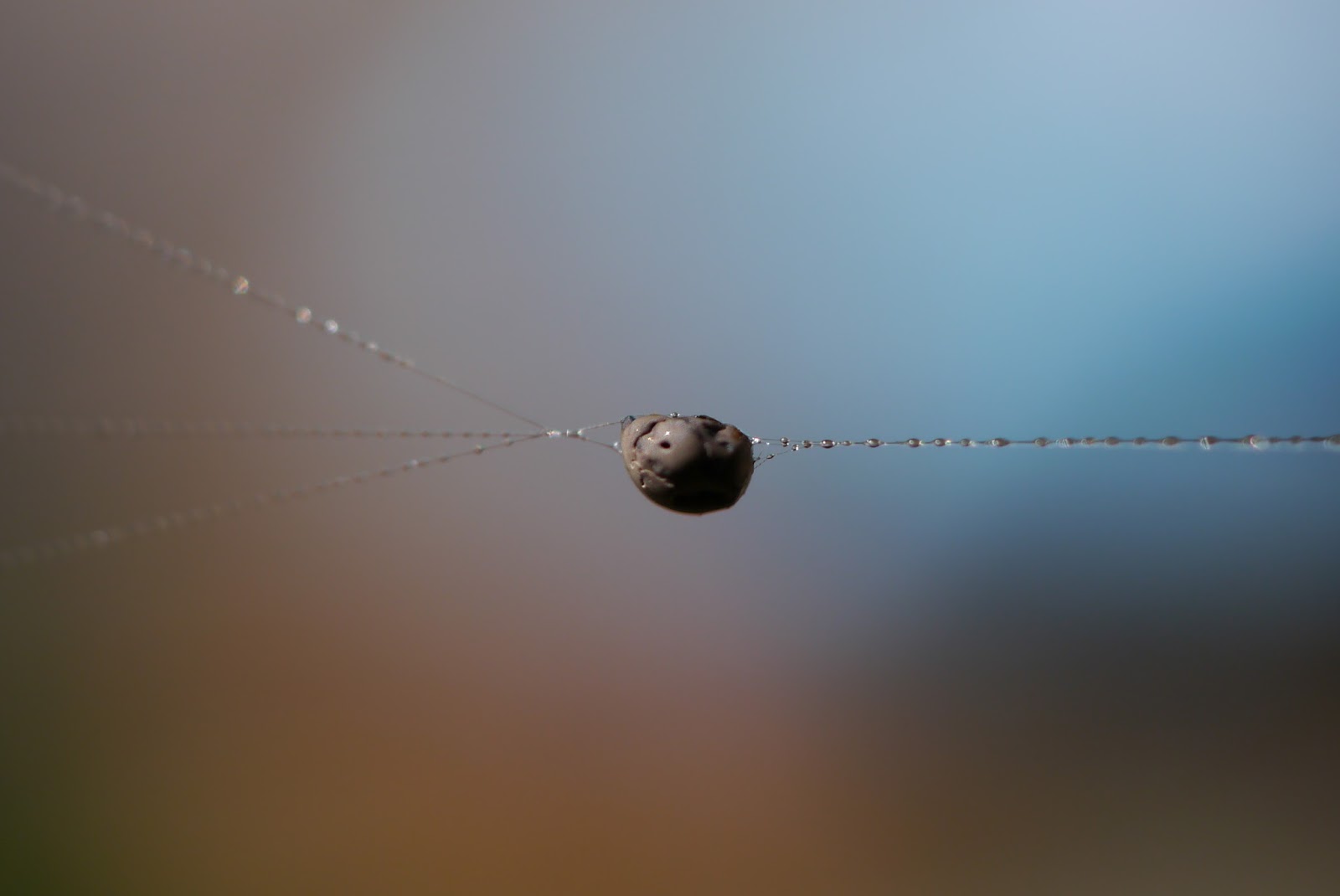
Strange spider web blob thing

Tuesday, 2 August 2016

Invasion Of The Lilly Snatchers

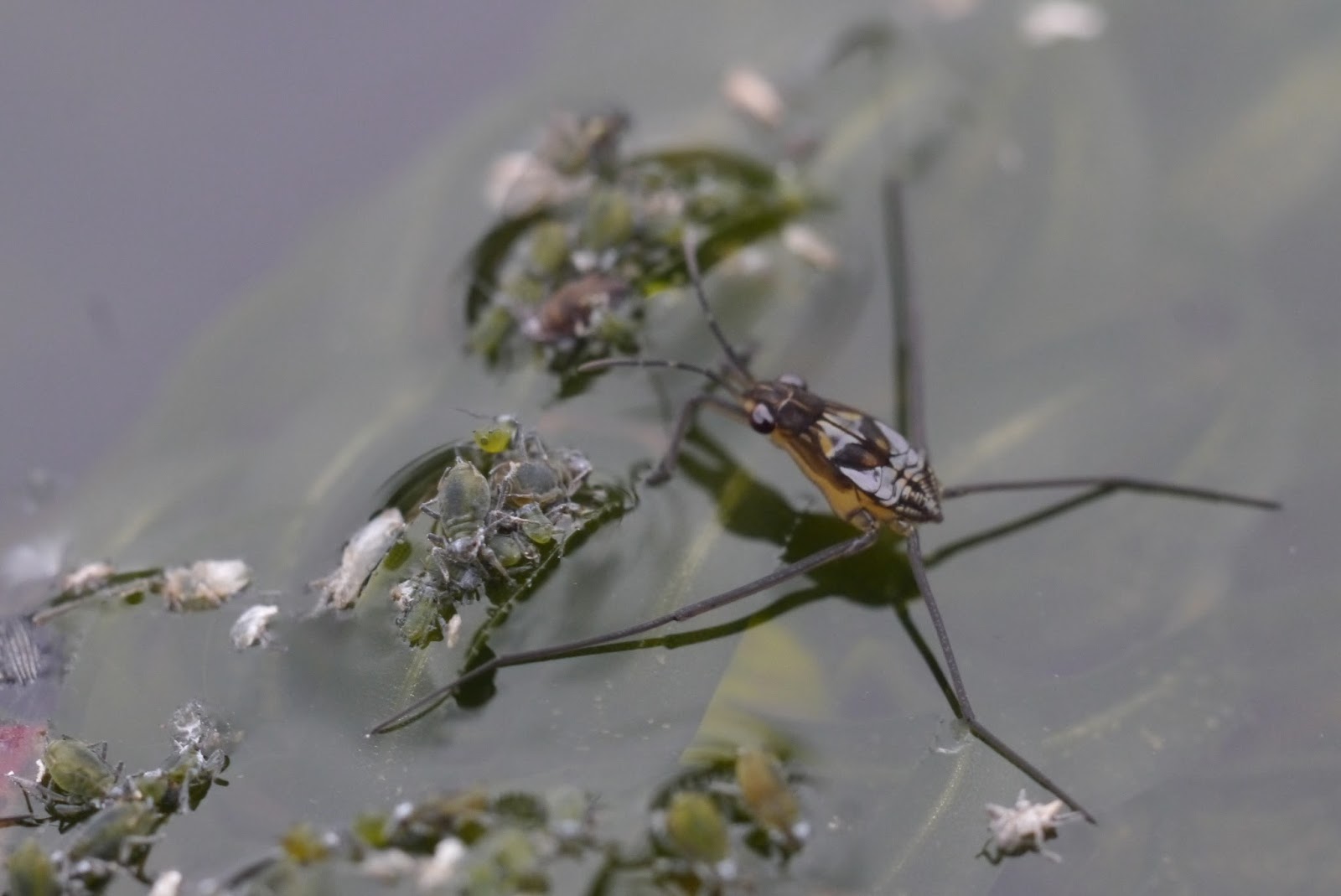
Last week I witnessed a strange phenomenon at the kitchen garden pond. The entire water surface was covered in a dusting of white flecks. It seemed to me that these were hatching flies of some kind, but it was not obvious what they were to the naked eye (not to my declining ones anyway). I returned with a macro lens to discover a flotsamic mess of drowning insects and shed skins. Where any plant protruded from the water it was covered in survivors as were the lilly pads and their flowers. This was, I was to discover, an explosion of Water Lilly Aphids.

As I tried to photograph these 1-3mm long sap suckers I began to notice all the predators in attendance. Lots of pond skaters and backswimmers, but more to my amazement was witnessing a tiny parasitic wasp come and inject her egg(s) into a hapless aphid (who was perhaps at the time wondering how it had had the good fortune to avoid the drowning fate of so many of its siblings).

On reviewing my photos I then saw more than one aphid carrying what looked like fly eggs on their backs. These I now believe to be hover fly eggs. I can't imagine the aphids have a particularly long life, so both wasp and fly larvae must develop very quickly, perhaps moving onto a secondary host if they themselves outlive the aphid?

Anyway, the moral of the ongoing story is that just because there are no fish in a pond it doesn't mean nothing is going on.


Mysterious debris on surface of kitchen garden pond


Debris revealed in close up as plague of Water Lilly Aphids

As I was attempting to get the aphid on the left in focus a tiny (3mm) parasitic wasp appeared...

The wasp also evaded my focus, but quickly approached the aphid...


Swiftly injected its egg...

...and left the scene in a blur

A huge number of predatory Pond Skaters also in attendance

Aphids on iris leaf. On the right of frame is an aphid covered in what I think are hover fly eggs

Aphids watched by Midge

Pond skater floating on floating feather floating

A Backswimmer, presumably partial to an aphid, but not witnessed doing anything unpleasant (unless you count breathing through its rear end).